



Angelenos Remember LAUSD Activist Sal Castro

Former students and colleagues paid their final respects and remembered the life and career of Sal Castro Thursday. A former LAUSD teacher, Castro participated in the 1968 Eastside school walkouts to protest inequities in education for Latinos.
Castro's work on behalf of inner-city schools and participation in the student marches was depicted in the 2006 HBO film "Walkout," directed by Edward James Olmos.
He died April 15 of natural causes at age 79, according to his family. His funeral service was held at the Cathedral of Our Lady of the Angels, and friends praised Castro's efforts to make life better for his Latino students.
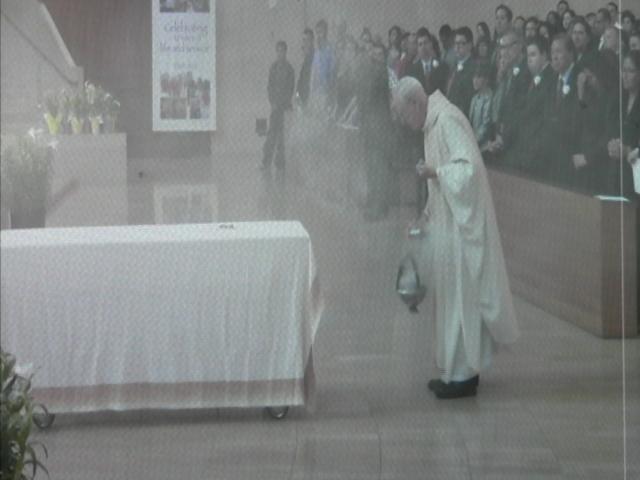
"Sal dedicated his life to education and for the betterment of educational opportunities for thousands upon thousands of young Chicano students," former California Supreme Court Justice Carlos Moreno said.
Castro worked at various inner-city schools before landing a teaching job at Belmont High School, where he taught social studies. Because of his activism with Spanish-speaking students, he was transferred to Lincoln High School in Lincoln Heights.
Castro was part of a committee that made recommendations to officials about ways of improving education for Latino students and he began working with students whose meetings became the Chicano Youth Leadership Conferences, which trained Latino student activists and leaders.
Castro became increasingly vocal in his criticism of inequalities between Eastside schools and other campuses. Unrest among activists and students led to walkouts -- which were later dubbed "Blowouts" -- that began in March 1968 with one school, then grew to include five campuses, including Lincoln High School and colleges.
The demonstrations eventually led to clashes between students and police. Castro was arrested and charged with disrupting schools and disturbing the peace, although the charges were later dropped.
"He put his career, and perhaps even his life, on the line for the students in this movement," Mario Garcia, a former professor at UC Santa Barbara, said. "He didn't do it because he personally wanted publicity or rewards. He did it because of the injustices of an educational system that for decades had denied Mexican American students a quality education."
A middle school on the campus of Belmont High School was named Sal Castro Middle School in his honor in 2009.
After Castro's death, Los Angeles County Supervisor Gloria Molina compared him to Cesar Chavez. "For Latinos in Los Angeles, Sal Castro was as influential and inspirational as United Farm Workers co-founder Cesar Chavez was nationally -- an example of the power of organizing who personified the possibility of overcoming seemingly insurmountable odds," Molina said.






Mr. Castro accomplished some great awareness of the inequalities between schools and improving education for Latino students. I admire him for that. However, Mr. Castro also tended to only focus on those points and in recent years, when I served on a local school site council with him, he showed his own form of racial and cultural preference and biases. He was only ever concerned about the Latino students in the school and not about serving an entire population of students in a Title I school. There were many at-risk students who were not of Latino heritage who had the same needs that he tended to choose to ignore. For all of the wonderful things he accomplished, he also had clay feet.